VV-D Adsorber: Instructions according to DIN82079.
Section 1: Information on the manufacturer
Section 2: Product overview
Section 3: Construction & material
Section 4: Technical data
Section 5: Assembly & commissioning
Section 6: Maintenance
Section 7: Spare parts & storage
Section 8: Disposal
Section 9: Risk & hazard analysis
Section 10: Maintenance plan
Section 1: Information on the manufacturer.
Giebel FilTec GmbH
Carl-Zeiss-Str. 5
74626 Bretzfeld
Germany
(+49) 79 46 9444 01-0
info@gf-dry.com
Section 2: Product overview.
Materials used
Polyamide(PA), polycarbonate (PC), polyvinylchloride (PVC), FKM, GIEBEL Xdry®, activated carbon
REACH Note
No ingredients requiring disclosure under Regulation (EC) No 1907/2006
Section 3: Construction & materials.
Section 4: Technical data.
Section 5: Assembly & commiccioning.
Section 6: Maintenance.
Section 7: Replacement & storage.
If the disposable adsorber is completely saturated, it must be replaced by a new one.
Section 8: Disposal.
At the end of its useful life, the device must be disposed of in accordance with the relevant legal regulations. The fully loaded adsorber can be disposed of in household waste. GIEBEL Xdry® is not classified as a hazardous substance under European Union legislation (Regulation EC No 1272/2008). It is not subject to compulsory labelling according to EC Directive (67/548/EEC or 1999/45/EC). GIEBEL Xdry® is not classified as a substance hazardous to health or the environment.
Section 9: Risk & harzard analysis.
1. Moist air flows into the system
Porous seals
Moist air can flow into the adsorber or into the plant at the porous points. As a result,
complete drying is not possible and moist air enters the system.
Saturated drying agent
When the desiccant is saturated, it can no longer absorb moisture. This allows moist air to
enter the system.
Air flow rate too high
If the air flow rate is too high, the contact time between moist air and desiccant is too
short. This allows moist air to flow into the system.
Oil on the drying agent
If too many oil particles enter the adsorber, the oil particles close the pores of the
desiccant and thus prevent adsorption.
Ambient temperature too high
If the ambient temperature exceeds 80°C, the binding forces in the desiccant decrease. As
a result, the incoming ambient air is only dried to a limited extent.
2. Positive or negative pressure builds up in the system
Air flow rate too high
Too high an air flow rate can cause over- or underpressure in the system.
Contaminated filter element
The filter unit can be clogged by dirt particles and can therefore build up pressure in the
system.
Oil on the drying agent
If oil particles get into the adsorber, the spaces in the fill can be filled with oil and the fill
will stick together. This can cause pressure to build up in the system.
3. Adsorber is damaged
Material resistance
When selecting the adsorber, the ambient and operating conditions should be considered.
An aggressive environment or liquid in the container can damage the adsorber.
Temperature range
The ambient and operating temperatures should not exceed or fall below the specified
range, otherwise the adsorber may be damaged.
Improper handling
Incorrect or improper handling can damage the adsorber. Please pay attention to the
recommended installation.
Strong vibrations
Strong vibrations of the plant can damage the adsorber.
Pressure range of the system
The adsorber should not be exposed to a positive or negative pressure above 0.5 bar,
otherwise the housing may be damaged.
Cleaning of the adsorber
For external cleaning of the adsorber, the use of a mild soap in combination with water is
recommended. The use of brake cleaner will damage the adsorber and is no reason for
complaint.
Section 10: Maintenance plan.
Check seals for wear
Cycle: Half yearly
Check
The o-ring installed on the adsorber must be checked for perfect condition. For this purpose, the seal at the connection should be checked for brittleness.
Measures
In case of existing damage, a new o-ring or a new adsorber should be
used.
Visual inspection of the desiccant
Cycle: Half yearly
Check
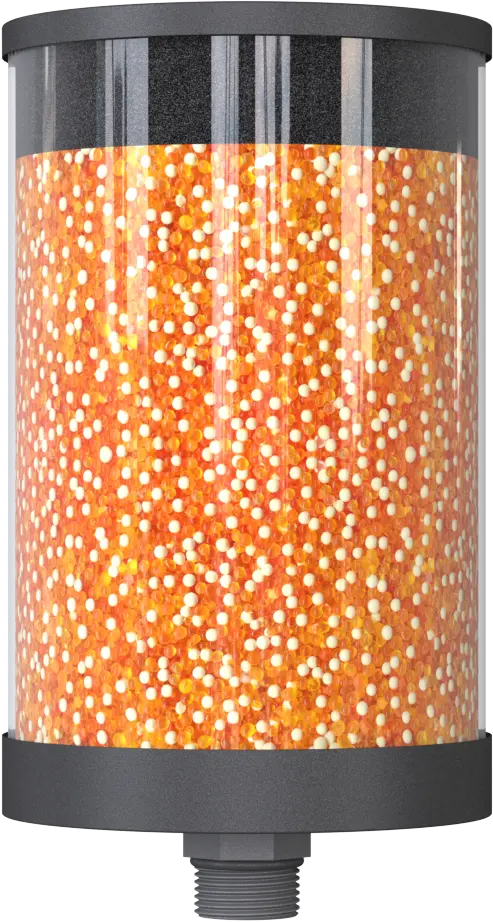
The loading condition of the desiccant must be determined by visual
inspection of the adsorber. The color orange indicates that the silica gel can
still adsorb water and air is dehumidified. If the desiccant is completely
saturated, the color changes to green or colorless.
If there are oil particles on the desiccant, these close the pores and the
adsorption capacity is reduced. This causes the desicant to discolor more
slowly and unevenly
Measures
If the desiccant is loaded or damaged by oil, a new adsorber with fresh
desiccant should be used.
Visual inspection of the adsorber
Cycle: Yearly
Check
The adsorber, including the connection, must be visually checked for damage. Damage can occur due to various environmental or operating conditions.
Measures
If the adsorber is damaged, it must be completely replaced to ensure full functionality.